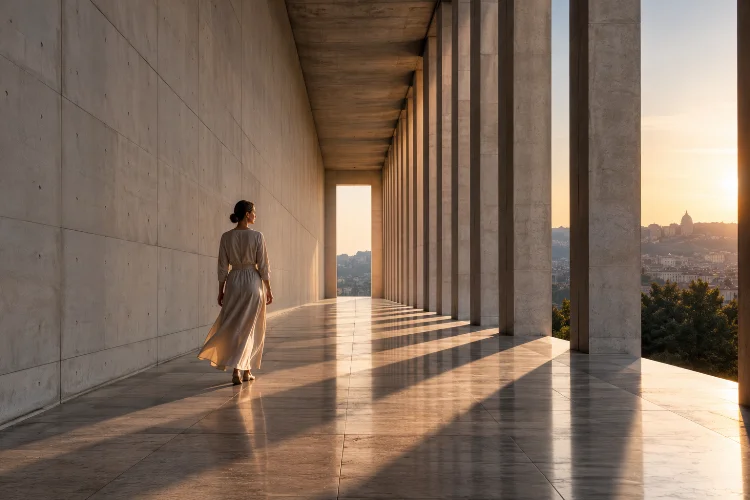
A photograph can contain an interesting subject, beautiful light, and technically perfect exposure yet still feel strangely weak. Often, the problem is not what appears in the image but where everything has been placed.
Subject placement controls how viewers enter a frame, where their eyes move next, and how much importance they give to different elements.
Moving a person only a few centimeters within the composition can change an image from static to energetic, comfortable to tense, or ordinary to surprisingly cinematic.
That is why designing stronger frames through intentional subject placement matters far beyond basic composition rules.
Good photographers do not simply point the camera toward something interesting. They think about visual weight, negative space, directional movement, background relationships, and how subjects interact with the edges of the frame.
Once placement becomes deliberate rather than accidental, composition starts doing more of the storytelling. The viewer no longer sees only a subject. They experience the relationship between that subject and everything surrounding it.
Start by Deciding What the Viewer Should Notice First
Before deciding where a subject belongs, decide what deserves the most attention.
This sounds obvious, but complicated scenes often contain several competing elements. A street photograph may include pedestrians, vehicles, signs, buildings, shadows, and reflections. Without a clear priority, the frame can become visually confusing.
A focal point gives the viewer somewhere to begin. StudioBinder describes focal points as the areas filmmakers intentionally use to direct attention toward important information, emotion, or environmental details.
Photography works the same way.
If the main subject is a person, their placement should usually help distinguish them from surrounding details.
You might position them against a cleaner background, place them near a strong contrast boundary, or surround them with enough empty space to make their importance immediately clear.
The goal is not always to make the subject huge. It is to make their role understandable.
Use the Rule of Thirds as a Starting Point, Not a Formula
The rule of thirds remains popular because it gives photographers a simple way to avoid placing every subject directly in the middle.
The technique divides the frame into a three-by-three grid. Positioning important elements near the lines or intersections often creates a balanced but slightly dynamic composition.
Nikon describes these intersections as useful positions for subjects because they can produce engaging and visually balanced photographs.
Adobe similarly explains that off-center positioning can create stronger balance and visual interest.
However, the rule should not become a checklist.
If every portrait automatically places an eye on exactly the same intersection, your photographs may eventually feel predictable.
Use the grid to understand balance first. Then experiment with moving the subject closer to the center, edge, top, or bottom of the frame.
Strong compositon comes from understanding why a position works, not simply copying coordinates.
Centered Subjects Can Create Strength and Stability
Photographers are sometimes taught that centered subjects are boring.
That is not really true.
Center placement can feel powerful when symmetry, directness, formality, or confrontation supports the story. Architecture, portraits, fashion images, and minimalist scenes often benefit from deliberate central framing.
Imagine a person standing exactly in the middle of a symmetrical hallway.
The architecture pulls attention inward from both sides. Instead of making the image dull, central placement strengthens the sense of order and control.
A centered portrait can also create direct psychological engagement. The viewer meets the subject immediately rather than exploring the frame first.
The important difference is intention.
A subject placed in the center because the photographer did not think about composition may feel ordinary. A subject centered because the surrounding lines, symmetry, expression, and visual weight support that decision can feel extremely strong.
Leave Space in the Direction of Movement or Attention
Where a subject is looking or moving has a major effect on how much surrounding space feels necessary.
Nikon recommends leaving more room in the direction a person, animal, or moving subject is facing or traveling. This gives the frame a more natural sense of continuation.
Imagine photographing a runner moving from left to right.
If the runner is placed close to the right edge, the frame may feel visually blocked. There is little room for the movement to continue.
Place the runner closer to the left side instead, leaving open space ahead.
Suddenly, the photograph contains implied direction.
The same principle applies to portraits. Someone looking toward empty space can create a feeling of reflection, expectation, or curiosity.
But this rule can also be reversed deliberately.
Placing a moving subject close to the edge they are approaching can create tension. The viewer may feel that the person is running out of space.
Intentional placement allows you to decide which emotional effect fits the story.
Use Negative Space to Increase Subject Importance
One of the easiest ways to make a small subject feel visually powerful is to surround it with quiet space.
Negative space reduces competition.
A person standing alone against a simple wall may occupy only a small percentage of the photograph but still dominate the entire image. The emptiness around them makes their presence more noticeable.
Adobe’s composition guidance recommends using negative space strategically when balancing photographic elements.
This technique is especially effective in editorial photography, architecture, travel images, environmental portraits, and minimalist scenes.
However, negative space does not need to be completely blank.
A soft sky, dark wall, blurred crowd, calm ocean, or shadowed interior can all function as visually quiet areas.
What matters is seperation.
The viewer should feel that one area carries information while another gives that information room to breathe.
Watch How Subjects Interact With the Frame Edges
The edges of a photograph are powerful compositional boundaries.
Subjects placed close to them can create tension, while generous distance from an edge can create comfort and stability.
This becomes particularly important when photographing people.
A face positioned extremely close to one side may feel compressed. A person looking directly toward a nearby edge can make the photograph feel intentionally uncomfortable.
That can be useful.
For example, an editorial portrait about uncertainty or pressure might benefit from less comfortable spacing. A relaxed lifestyle portrait may work better with more breathing room.
Pay attention to accidental tangencies as well.
A person’s head barely touching a window frame or a hand aligning awkwardly with the edge of the photograph can make an otherwise strong image feel visually messy.
Before pressing the shutter, scan the perimeter of the frame.
Often, moving the camera slightly left, right, higher, or lower solves the problem without changing the main subject at all.
Position Subjects in Relation to the Background
Subject placement should never be considered independently from the background.
A person may look perfectly positioned on a composition grid but still merge with a tree, doorway, bright sign, or another person behind them.
This is why photographers need to evaluate layers rather than only the main subject.
Try moving sideways before asking the subject to move.
A small change in camera position can place a clean wall behind someone’s head, reveal a stronger leading line, or separate overlapping figures.
Depth also matters.
StudioBinder notes that composition can use spatial relationships and depth of field to communicate connections between objects and characters.
Imagine photographing two people in a café.
Placing them close together within the same visual plane may suggest intimacy. Separating them across foreground and background can create emotional distance.
The enviroment therefore becomes part of subject placement rather than just decoration.
Balance One Subject Against Secondary Elements
A strong frame does not always need one isolated focal point.
Sometimes the most interesting compositions contain a main subject balanced by smaller secondary elements.
Imagine a cyclist occupying the lower-left portion of a city photograph. On the upper-right side, a bright window or distant pedestrian may provide enough visual weight to balance the cyclist without competing with them.
The two elements do not need to match in size.
Visual hierarchy can be influenced by scale, color, brightness, contrast, and position. The Interaction Design Foundation notes that size and color are common tools for establishing differences in importance within visual layouts.
The same principle applies to photographs.
A large neutral subject may be balanced by a much smaller bright one.
Learning to see these relationships is essential for advanced framing because balance is perceptual rather than mathematical.
Break Composition Rules When the Story Benefits
Rules are valuable because they teach photographers what viewers usually expect.
Breaking them becomes interesting when you understand those expectations.
Adobe specifically notes that centered framing or other departures from the rule of thirds can work effectively when they are intentional.
You might push a subject unusually close to a corner, leave excessive space above them, crop part of their body, or deliberately place them behind another foreground object.
These decisions can create tension, mystery, scale, or a stronger sense of observation.
The important question is always the same: what does the unusual placement add?
If moving the subject away from a conventional position strengthens the mood or information in the image, the choice has a purpose.
If it only makes the photograph look different, the effect may feel forced.
Advanced composition is not about constantly breaking rules. It is about knowing when the rules no longer serve the story.
Practice Subject Placement by Shooting Variations
The fastest way to understand placement is to photograph the same scene several ways.
Do not stop after finding the first acceptable composition.
Place the subject in the center, then near a third. Move them closer to an edge. Add negative space. Lower the camera. Change the background relationship.
Nikon encourages photographers to experiment with alternative positioning rather than assuming the first frame is automatically the strongest one.
Compare the results later.
You will often notice that tiny positional changes create surprisingly large differences in mood and visual strenght.
Eventually, these decisions become faster.
Instead of consciously thinking about every composition rule, you begin recognizing when a frame feels balanced, tense, open, or crowded before pressing the shutter.
Intentional subject placement can transform an ordinary photograph because position affects attention, balance, movement, emotion, and visual hierarchy at the same time.
The rule of thirds can provide a useful foundation, but stronger framing comes from understanding when to center subjects, use negative space, create directional room, approach frame edges, or balance one subject against another.
The goal is not to find one perfect position that works for every photograph.
Instead, treat placement as part of storytelling. Move yourself, explore different angles, examine the background, and create several versions before deciding what feels strongest.
The more consciously you position subjects within the frame, the more control you gain over how viewers experience the image – and the more purposeful your photography becomes.