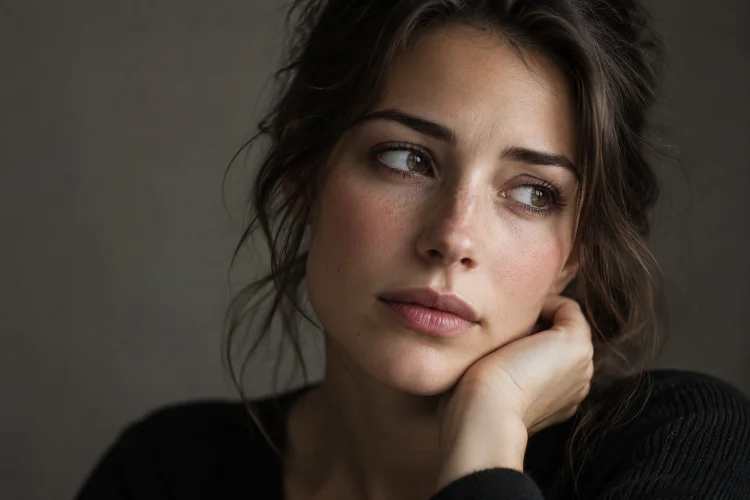
Two portraits taken less than a second apart can feel like photographs of completely different people.
In one frame, the subject looks confident and open. In the next, a slight tightening around the eyes or a tiny change in the mouth creates uncertainty, tension, or vulnerability.
That difference reveals the power of small facial movements.
In scientific research, micro-expressions generally refer to very brief facial expressions that can occur within a fraction of a second. In everyday portrait photography, however, the term is often used more loosely to describe subtle, fleeting changes in expression.
Research also warns against assuming that one facial movement reliably reveals someone’s hidden emotional state; context strongly affects how expressions are perceived.
Understanding how micro-expressions change the emotional impact of portraits is therefore not about becoming a human lie detector.
It is about learning to notice tiny changes in the face, capturing meaningful transitions, and recognizing how viewers may interpret those details when they encounter a still photograph.
Small Facial Changes Can Completely Shift a Portrait
The human face is incredibly dynamic.
A portrait may look almost identical from frame to frame, yet viewers can perceive noticeably different moods because the eyebrows, eyelids, cheeks, or mouth have shifted slightly.
The Facial Action Coding System, commonly known as FACS, was developed specifically to describe observable facial movements.
Instead of labeling a face simply as “happy” or “angry,” FACS breaks visible movements into individual Action Units associated with different muscular actions.
For photographers, you do not need to memorize those codes.
The practical lesson is simpler: expression is made from many small components.
A slight eyebrow raise can make a neutral portrait seem questioning. Tighter lips might introduce restraint. Softer eyelids combined with relaxed cheeks can change the entire feeling of someone’s gaze.
This is why portrait selection deserves more attention than simply choosing the sharpest frame.
The technically perfect photograph may not carry the strongest emotional presence.
The Eyes Often Change How the Entire Face Is Read
Portrait photographers naturally pay enormous attention to the eyes, and for good reason.
Small changes around the eyelids and cheeks can influence how a smile or neutral expression is percieved. Researchers have long studied the so-called Duchenne smile, which combines movement around the mouth with contraction around the eyes.
However, newer research suggests photographers should be cautious about treating “smiling eyes” as guaranteed proof of genuine happiness.
Studies have questioned whether this facial configuration uniquely indicates authentic positive emotion, with smile intensity and context also affecting interpretation.
That nuance is useful in photography.
Instead of asking, “Is this expression genuine?” ask, “How does this expression feel in the photograph?”
A broad smile with strongly narrowed eyes may appear energetic and expressive. A similar mouth shape combined with calmer eyes may feel restrained or formal.
Neither interpretation automatically tells you exactly what the person was feeling internally.
Photography captures visible behavior, while viewers construct meaning from it.
That distinction is important.
The Mouth Can Change Mood With Tiny Movements
The mouth is another highly influential area.
Consider how different a portrait feels when the corners of someone’s mouth rise slightly compared with remaining completely neutral. The change may involve only a few millimeters, but the emotional tone can shift considerably.
Research into smile dynamics has found that factors such as mouth angle, smile extent, asymmetry, and timing influence how smiles are judged by observers.
One experimental study involving hundreds of participants found that changing spatial and temporal characteristics altered whether smiles were perceived as effective, pleasant, or genuine.
For portrait photographers, this means “smiling” is not a single expression.
There are dozens of useful moments between neutral and a full smile.
A restrained half-smile may work beautifully for an editorial portrait. A rapidly growing smile can create energy during a lifestyle session. A nearly neutral mouth may make a corporate portrait feel calm and controlled.
Instead of waiting only for the maximum smile, photograph the transition.
Those intermediate frames frequently contain more personality.
Expression Timing Matters More Than Photographers Realize
A still portrait freezes something that normally unfolds through time.
That creates an interesting challenge.
Research on facial emotion perception increasingly emphasizes that facial movement and timing provide information that static photographs alone cannot fully reproduce.
A 2023 review in Nature Reviews Psychology notes that much traditional research used photographs of expressions at their peak, while dynamic information can contribute additional cues to emotion recognition.
Photographers experience this problem constantly.
Ask someone to smile and there may be several stages: anticipation, the beginning of the smile, the full expression, and relaxation afterward.
Every stage can create a different photograph.
The full smile may look enthusiastic. The moment immediately before it might feel playful. The expression immediately afterward may appear quieter and more intimate.
This is why experienced portrait photographers often keep shooting around the “main” expression.
The emotional frame may happen before or after the moment you originally planned.
Brows and Forehead Add Subtle Emotional Tension
Eyebrows are easy to overlook during a portrait session because photographers often concentrate on eyes and mouths.
Yet their position can dramatically change facial communication.
Raised brows may add curiosity, surprise, openness, or uncertainty depending on the rest of the face and the surrounding context. Lowered or slightly drawn brows can make an otherwise neutral portrait appear more concentrated or intense.
The important phrase is depending on context.
Research increasingly challenges the simplistic idea that individual facial configurations map perfectly onto universal internal emotional states. Cultural context, situational information, conceptual knowledge, and other facial movements can all affect interpretation.
For photographers, that means you should judge the full portrait.
A furrowed brow photographed during an athlete’s training session might suggest concentration. A similar movement in a quiet environmental portrait could be interpreted as concern or seriousness.
The face never operates separately from the story surrounding it.
Transition Frames Often Feel More Authentic
One of the easiest ways to capture subtile expressions is to stop photographing only finished poses.
Watch transitions.
Ask your subject to look away and then slowly return their gaze toward you. Let them laugh and continue photographing as the smile disappears. Start a conversation and shoot while they are thinking about an answer.
These moments can create expressions that are difficult to manufacture deliberately.
Micro-expression research itself focuses heavily on brief and spontaneous facial activity because fleeting movements can be difficult to detect and classify.
Reviews of the field emphasize just how challenging these very short expressions are to identify reliably, especially among ordinary movements such as blinking or speaking.
For photographers, the lesson is not to analyze every twitch.
It is to remain observant.
Sometimes the strongest portrait occurs when the subject has temporarily forgotten about maintaining a camera-ready expression.
Those transition frames can feel less polished—and more human.
Context Changes the Meaning of the Same Expression
A facial expression never exists in isolation inside a photograph.
Lighting, composition, clothing, posture, location, and surrounding objects all influence interpretation.
Imagine exactly the same neutral expression photographed in two situations.
In the first image, the person sits in warm window light inside a comfortable home. In the second, they stand alone beneath harsh lighting in an empty industrial space.
The face has not changed.
The emotional reading probably has.
Research on emotion perception supports the idea that viewers bring conceptual knowledge and contextual expectations into how facial information is interpreted. What observers think they see in a face is not determined only by individual muscle movements.
This is particularly important for editorial portraiture.
Photographers can unintentionally change how a subject is perceived through environmental choices.
A tight crop may intensify a slight expression. A wider portrait may shift attention toward the enviroment. Dramatic shadow can make the same face feel more mysterious than soft frontal light.
Expression and composition work together.
Avoid Treating Micro-Expressions as Proof of Hidden Emotion
The fascination with micro-expressions has produced one persistent misconception: that a brief facial movement can automatically reveal what someone is “really” feeling.
That conclusion is much stronger than the evidence supports.
Although micro-expressions are a legitimate area of research, automatically recognizing and interpreting them remains challenging. Scientific debate also continues around how reliably particular facial configurations correspond to specific emotions.
This matters ethically in portrait photography.
A photographer might capture a split-second grimace during an otherwise pleasant conversation. Publishing that single frame could make the person appear angry, uncomfortable, or hostile even if it poorly represents the broader interaction.
Selection therefore becomes part of storytelling responsibility.
The camera can isolate moments that the naked eye might barely register. That power can create extraordinarily expressive portraits, but it can also create misleading ones.
Choose frames because they communicate the intended story fairly, not merely because an unusual expression looks dramatic.
Learn to Observe Before Trying to Control
Capturing meaningful facial details becomes easier when you learn how each subject naturally behaves.
Some people raise their eyebrows while speaking. Others smile before answering questions. Some become most expressive while listening rather than talking.
Watch before directing too aggressively.
During the first few minutes of a session, notice how the person’s neutral face looks. Observe how their expression changes during conversation.
Then use simple prompts rather than ordering specific facial movements.
Ask them to think about something, look toward a window, respond to a question, or move naturally before returning their gaze toward the camera.
This produces a range of expressions rather than one fixed “portrait face.”
When reviewing your images later, compare neighboring frames instead of judging each photograph individually.
You may be surprised by how dramatically a tiny change around the mouth, eyes, or brows changes the emotional impact.
Micro-expressions and other fleeting facial movements can give portraits remarkable emotional depth.
Small changes around the eyes, mouth, brows, and cheeks may transform a frame from confident to vulnerable, restrained to energetic, or distant to intimate.
But these details should be interpreted carefully. A photograph records visible facial behavior, not a guaranteed reading of someone’s private emotional state.
During your next portrait session, keep shooting through transitions instead of waiting only for perfect poses. Watch what happens before a smile, after laughter, during thought, and between directions.
Compare consecutive frames and study how tiny differences change your response. The better you become at noticing these moments, the more intentional – and emotionally compelling – your portrait photography can become.