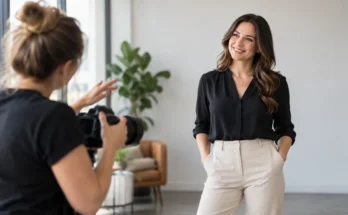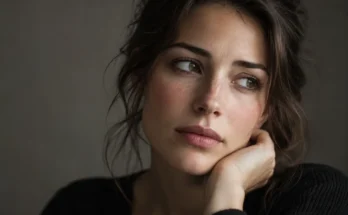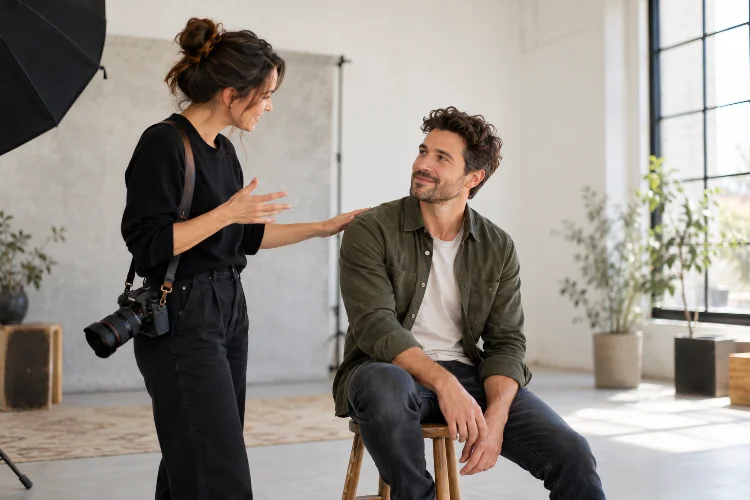
Most people are not professional models. The moment a camera points toward them, even confident people can suddenly forget what to do with their hands, shoulders, face, or posture.
That is why portrait photography involves much more than choosing the right lens and lighting.
A good photographer needs to know how to guide someone without making them feel as though they are following a complicated posing manual. The best portrait direction usually feels more like a conversation than a series of commands.
Learning how to direct natural poses during professional portrait sessions can help you create images that look polished while still feeling authentic.
Instead of forcing people into rigid positions, photographers can use simple prompts, small body adjustments, movement, and comfortable interaction.
The goal is not to eliminate posing altogether. It is to make posing feel invisible. When direction becomes clear, relaxed, and easy to follow, subjects spend less time worrying about the camera and more time simply being themselves.
Build Comfort Before You Start Directing Poses
Natural-looking portraits usually begin before the first photograph is taken.
If someone feels uncomfortable around the photographer, that tension often appears in their shoulders, hands, jaw, and facial expression. Building rapport can make directing poses much easier.
Nikon photographer Robert Vasquez describes taking time to talk with a subject before continuing a shoot and finding that the resulting portraits became noticeably more relaxed.
He recommends making time to build rapport because that relationship can appear in the final photographs.
You do not need a long conversation.
Ask about their day, explain what you are planning, or tell them what will happen during the session. Simple comunication removes some of the uncertainty people feel in front of a professional camera.
Instead of immediately saying, “Stand here and turn your head,” spend a few moments creating a comfortable atmosphere.
A relaxed subject is much easier to direct than someone who feels they are being tested.
Give Simple Instructions Instead of Complicated Pose Descriptions
Photographers sometimes see a complete pose in their minds and then attempt to explain every detail at once.
That can overwhelm the subject.
“Turn your shoulders slightly, move your left foot back, shift your hip, rotate your wrist, lower your chin, and look over here” sounds simple to the photographer. To the person hearing it, it can feel like choreography.
Break instructions into small adjustments.
Start with the body position. Once that feels right, adjust the shoulders. Then refine the hands, chin, and eyes.
Adobe recommends preparing pose ideas in advance and giving subjects understandable instructions for sitting and hand positions. Planning allows the photographer to focus more easily on the person during the actual session.
Demonstrating can also work better than explaining.
If you want someone to lean slightly against a wall, show them. People can often copy a physical position much faster than they can interpret several verbal directions.
Use Movement Instead of Asking People to “Pose”
Standing perfectly still is one of the fastest ways to make someone look stiff.
Movement creates natural transitions between poses.
Ask the subject to walk slowly toward you, take two steps away and turn back, adjust their jacket, move their hair, sit down, or shift their weight from one foot to another.
These actions give the body something real to do.
Portrait photographers often find that natural expressions appear during transitions rather than during the final pose itself.
Fstoppers highlights action-based prompts such as walking toward the camera as a useful method for creating more relaxed portraits than asking someone to remain stationary for too long.
You do not necessarily need the biggest movement.
Even asking someone to breathe out, look away, and then return their eyes toward the camera can reset an awkward expression.
Keep shooting through those transitions.
The frame immediately before or after the “official” pose may be the one that feels most naturaly alive.
Angle the Body to Avoid a Stiff, Square Pose
One of the simplest portrait adjustments is changing the angle of the body.
When someone stands completely square to the camera, shoulders can look rigid and the pose may feel overly formal. Turning the torso slightly often introduces shape and dimension.
Nikon recommends having portrait subjects turn their bodies somewhat away from the camera and then rotate their heads back toward it for a more flattering result.
Adobe similarly suggests slightly angling the body while keeping the face oriented toward the camera to create more dimension.
This does not require an extreme rotation.
A small change can be enough.
For standing portraits, try asking the subject to shift most of their weight onto one leg. The other knee can relax slightly, which prevents both legs from appearing equally rigid.
For seated portraits, turning the knees slightly away from the camera while bringing the upper body back toward the lens can create a relaxed but structured position.
These adjustments are subtle, but they can change the entire body language of the portrait.
Give the Hands Something Useful to Do
Hands are one of the biggest sources of anxiety during portrait sessions.
As soon as someone asks, “What should I do with my hands?” the photographer needs an answer.
Leaving both arms hanging straight beside the body can sometimes work, but it frequently feels unnatural. Instead, give the hands a reason to exist within the image.
A subject might place one hand inside a pocket, lightly touch a jacket, hold glasses, rest an arm on a chair, adjust a sleeve, or gently connect their hands.
Adobe notes that hands and seated poses benefit from deliberate planning because awkward placement can quickly become distracting.
Avoid making every hand position too precise.
You generally want relaxed fingers rather than tightly pressed hands. If the subject starts gripping an object, ask them to loosen their fingers.
Also watch for hands pressed firmly against the body. This can flatten their shape visually.
A little separation between the arms and torso often creates cleaner lines and makes the pose feel less constrained.
Direct Expressions Through Conversation, Not Just “Smile”
“Smile.”
It may be the most common direction in portrait photography, but it does not always produce the best expresion.
People often react to the command by creating a camera smile rather than a genuine one. Their mouth changes, but their eyes remain tense.
A better approach is to generate the expression indirectly.
Talk to the person. Ask a light question, make a small joke when appropriate, or give them something to think about.
Nikon recommends connecting with portrait subjects while shooting, including talking with them, making them laugh, or asking them to look away for more candid results.
For serious portraits, do not simply say, “Look serious.”
Give more specific emotional direction.
Try asking them to relax their mouth, look slightly past the camera, or take a slow breath before returning their gaze to the lens.
Watch what happens between instructions as well.
Sometimes the strongest expression appears the moment someone thinks the photograph has already been taken.
Make Small Adjustments to the Chin, Shoulders, and Posture
Once the basic pose feels natural, tiny refinements can make it more polished.
The chin is a good example.
If someone pulls their head backward, the jawline can become less defined. A small movement of the forehead or chin toward the camera can improve facial structure without requiring an exaggerated position.
Adobe recommends subtle chin positioning—slightly forward and down—as one way to improve definition while keeping the portrait natural.
Shoulders deserve similar attention.
Subjects often unconsciously lift them when nervous. Simply saying, “Drop your shoulders and relax for a second,” can make a surprisingly large difference.
Watch posture without forcing everyone into a perfectly straight position.
A slight lean toward the camera can create engagement. A gentle lean against a wall or chair may make the pose feel calmer.
The key is using subtile corrections rather than rebuilding the entire pose after every frame.
Too many adjustments can make subjects start overthinking their bodies.
Adapt Your Direction to the Person in Front of You
There is no universal collection of poses that works equally well for everyone.
A corporate executive, musician, couple, teenager, actor, and family may all need very different types of direction.
Some subjects are comfortable moving freely. Others prefer clear instructions.
Professional Photographers of America emphasizes that clear, supportive communication helps clients feel more comfortable throughout a photographic experience.
Pay attention to how your subject responds.
If movement prompts create confident portraits, keep using them. If the person seems more comfortable sitting, build the session around chairs, tables, stairs, or other natural supports.
Fstoppers notes that chairs can help subjects feel less exposed while giving their bodies and hands more obvious places to settle.
Do not force someone into a pose merely because it worked beautifully during another session.
Natural portrait posing depends on personality, clothing, setting, body language, and the purpose of the final photograph.
Your job is not to make everyone pose the same way. It is to find direction that gives each person more confidentce in front of the lens.
Keep Shooting Between the “Perfect” Poses
A professional portrait session should have structure, but it should not feel mechanical.
Once you establish a strong basic position, allow small variations to happen.
Ask the subject to look away and back. Let them reset their hands. Continue talking while adjusting your own camera position.
Fstoppers recommends slowing the process occasionally and allowing casual conversation to reveal more authentic body language and expressions.
These in-between frames often contain something difficult to manufacture: genuine relaxation.
Technically perfect posture is not always the same as a compelling portrait.
Sometimes a slightly uneven smile, a natural lean, or a brief glance away from the camera gives an image far more personality than the most carefully constructed pose of the session.
Give yourself enough time to notice those moments.
Directing natural portrait poses is less about memorizing dozens of positions and more about helping people feel comfortable enough to move naturally.
Clear instructions, simple body angles, purposeful hand placement, movement prompts, subtle posture adjustments, and genuine conversation can turn stiff poses into believable portraits.
The best photographers guide without making every adjustment feel like a command.
During your next portrait session, start with one simple pose and build from there. Watch the shoulders, hands, chin, and expression, but also pay attention to what happens between poses.
Keep talking, demonstrate when necessary, and adapt your direction to the individual. When your subject stops thinking about posing, you are often closest to capturing the portrait you wanted.