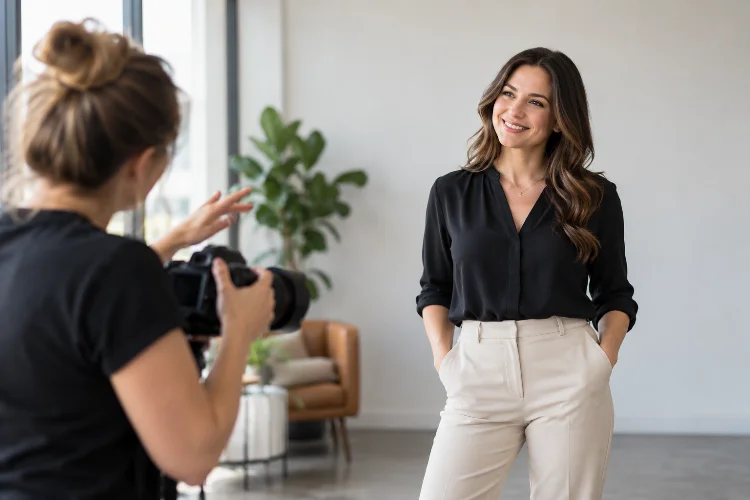
Photographing professional models can feel straightforward because they already understand posing, angles, posture, and how to respond to a camera. Photographing someone who rarely has professional photos taken is a completely different experience.
The moment the camera appears, many people suddenly become aware of their hands, shoulders, smile, and every small movement they make. Even confident professionals can look uncomfortable when they are unsure what the photographer expects.
That is why directing non-models for more confident professional portraits is less about complicated poses and more about communication. Your job is to remove uncertainty, create simple actions, and give the subject enough feedback to feel that they are doing well.
Great direction should not make someone feel controlled. It should make them feel supported.
When photographers combine clear instructions with movement, conversation, small posture adjustments, and thoughtful pacing, ordinary people can look relaxed, capable, and genuinely comfortable in front of the lens.
Build Comfort Before You Start Posing
The first few minutes of a portrait session can determine the mood of everything that follows.
If the subject immediately feels rushed into position, they may assume every movement is being judged. That tension often appears in raised shoulders, stiff hands, tight smiles, and rigid posture.
Start with conversation instead.
Explain what you are going to do and reassure them that they do not need to know how to pose. Let them know you will guide them through the session.
This small piece of comunication removes a surprising amount of pressure.
Professional Photographers of America emphasizes the importance of clear client communication because expectations and trust influence the overall photography experience.
A subject who understands the process is more likely to participate comfortably rather than constantly wondering what comes next.
Confidence often starts before you take the first serious frame.
Give One Instruction at a Time
Non-models become overwhelmed when photographers give five directions simultaneously.
“Turn your body, move your foot, relax your shoulder, lift your chin, and look toward the window” might make perfect sense in your head. To someone already nervous, it can feel like trying to remember choreography.
Break the pose into stages.
First, position their feet. Then adjust the torso. Once that looks comfortable, work on shoulders, hands, chin, and gaze.
Adobe’s portrait guidance recommends using understandable posing instructions and demonstrating positions when useful. Showing someone what you mean is often much faster than describing the exact angle of an arm or shoulder.
Keep your language simple.
Instead of saying, “Rotate your torso approximately forty-five degrees,” try, “Turn a little toward that wall.”
Good direction should reduce thinking, not create more of it.
Start With Comfortable Poses Before Trying Anything Creative
Every portrait session needs momentum.
Starting with an unusual or demanding pose can immediately make an inexperienced subject feel unsuccessful. Begin with positions that resemble how people naturally stand or sit.
Ask them to stand with their weight slightly more on one leg. Let one hand rest in a pocket. Have them lean casually against a wall or sit slightly angled in a chair.
Nikon’s portrait guidance suggests turning the body slightly away from the camera rather than automatically keeping both shoulders square to the lens. Small changes in body angle can add dimension while still feeling natural.
Once the subject sees a few good images and realizes they are looking great, their confindence often improves quickly.
That is when you can introduce more creative variations.
A portrait session usually becomes easier as it progresses, so save some of your more unusual ideas until the person has settled into the experience.
Give the Hands a Clear Job
Hands are often the first thing non-models worry about.
“What do I do with my hands?” is almost guaranteed to appear during a portrait session.
Have several simple answers ready.
One hand can go lightly into a pocket. The subject might adjust a cuff, hold glasses, touch a jacket, rest an arm on a chair, or loosely connect both hands.
Adobe’s guidance on hand posing recommends planning positions deliberately and using objects when they help the pose feel more natural.
Avoid leaving people holding their fingers in a strange frozen shape.
Ask them to loosen their hands between frames. If fingers look tense, have the subject shake their hands briefly before returning to the pose.
Watch how firmly they press their arms against their torso as well. Creating a little seperation between the arms and body often produces cleaner lines.
The goal is not perfect hand choreography.
The hands simply need to look like they belong to a relaxed person rather than someone suddenly wondering what hands are for.
Use Movement to Make Posing Feel Less Artificial
People often look stiff because they have been standing still for too long.
Instead of constantly adjusting a static pose, give the subject something to do.
Ask them to walk toward you, take a few steps away and turn back, adjust their jacket, sit down slowly, or shift their weight from one leg to the other.
Movement creates natural body positions.
It also produces transition frames that often feel more convincing than the final pose.
A subject walking toward the camera is not thinking about exactly where every finger should be. Their arms move naturallly, their shoulders loosen, and their facial expression often becomes more spontaneous.
Movement does not need to be dramatic.
Even asking someone to look away, breathe out, and then return their gaze can reset a stiff expression.
Continue photographing while they move. The frame between two poses may become the strongest portrait of the session.
Correct Posture Without Making the Subject Self-Conscious
Posture matters, but constant criticism quickly damages confidence.
Avoid saying things like, “You look stiff,” or “That pose is awkward.”
Instead, tell the subject what to do next.
“Relax your shoulders a little.”
“Bring your forehead slightly toward me.”
“Shift your weight onto your back foot.”
“Perfect – keep that.”
The wording matters.
Positive reinforcement helps subjects understand which movements are working. Professional portrait sessions should feel collaborative rather than corrective.
Small changes are usually enough.
Someone who naturally slouches does not need to stand like a military officer. You might simply ask them to lengthen their posture slightly or lean forward from the hips.
Likewise, lifting the shoulders repeatedly may indicate nervousness. Asking the person to breathe out before the next frame can relax both posture and expression simultaneously.
Photographers should refine what already feels natural instead of rebuilding every person into the same pose.
Create Expressions Through Conversation
The command “smile” often creates exactly what it sounds like: a smile performed for the camera.
For more believable expressions, create something to respond to.
Ask the subject a question related to their work, hobbies, family, travel, or something they enjoy discussing. If appropriate, use humor.
Nikon’s portrait advice encourages photographers to talk with subjects and create interaction rather than remaining silent behind the camera.
Watch closely while they answer.
The best expression may appear while they are thinking, listening, laughing, or reacting to something you said.
You can also use simple prompts.
Ask someone to look away for a moment and return their eyes to the lens. Tell them to take a breath, relax their mouth, or think about walking into a meeting they feel completely prepared for.
These instructions produce emotional direction without asking the subject to manufacture a specific facial expression.
Show Them Successful Frames During the Session
One simple technique can dramatically improve a nervous subject’s confidence: show them a good photograph.
Not every frame needs to be reviewed together, but letting someone see that the session is working can remove a lot of anxiety.
Choose a strong image rather than randomly showing the most recent shot.
Say something simple such as, “This is working really well.”
Once people realize they look good, they often stop trying so hard.
Their shoulders relax. Their expressions become less controlled. They become more willing to experiment.
Be careful not to turn the session into constant screen checking, though.
The goal is reassurance, not interruption.
A few strategic previews can build trust while keeping the shoot moving.
Adapt Your Direction to Different Personalities
Some people want detailed instructions. Others feel uncomfortable when every centimeter of their posture is controlled.
Pay attention.
A corporate executive who prefers clear structure may respond well to precise directions. A creative professional might produce better results when given loose movement prompts.
A quiet person may need more time between instructions, while an energetic subject might benefit from constant movement.
There is no universal formula for posing non-models.
Your approach should also reflect the intended portrait.
A formal leadership portrait needs different body language from a relaxed lifestyle image. An editorial musician portrait may benefit from unusual positioning that would feel unnecessary in a corporate headshot.
The photographer’s ability to adapt is often more important than having a long list of poses.
Keep Shooting After the Pose Is Finished
A strange thing happens when photographers say, “Great, we got it.”
Subjects relax.
That exact moment is often worth photographing.
The shoulders drop, the camera smile disappears, and the person returns to their normal expression. These transitional moments can produce portraits that feel far more authentic.
Do not make the entire shoot a continuous stream of instructions.
Give people short pauses.
Talk while adjusting the camera. Let them reset their body. Photograph the moment they prepare for the next pose.
The strongest professional portrait does not always come from the most carefully constructed position.
Sometimes it appears when the subject briefly forgets they are being posed at all.
Directing non-models successfully is not about turning ordinary people into professional models. It is about giving them enough guidance to feel comfortable, capable, and confident in front of the camera.
Start with trust, use simple instructions, give hands a purpose, introduce movement, refine posture gently, and create expressions through conversation rather than commands. Most importantly, adapt your direction to the person in front of you.
During your next professional portrait session, focus less on finding one perfect pose and more on creating a smooth experience.
Give positive feedback, photograph transitions, and make small adjustments instead of overwhelming the subject. When people stop worrying about what they are doing, confident portraits become much easier to create.