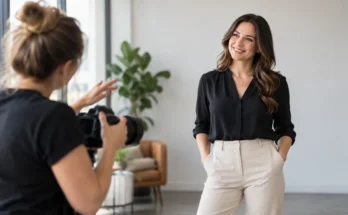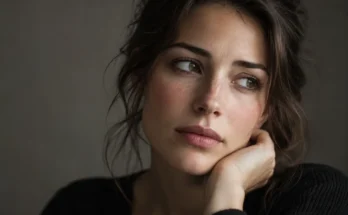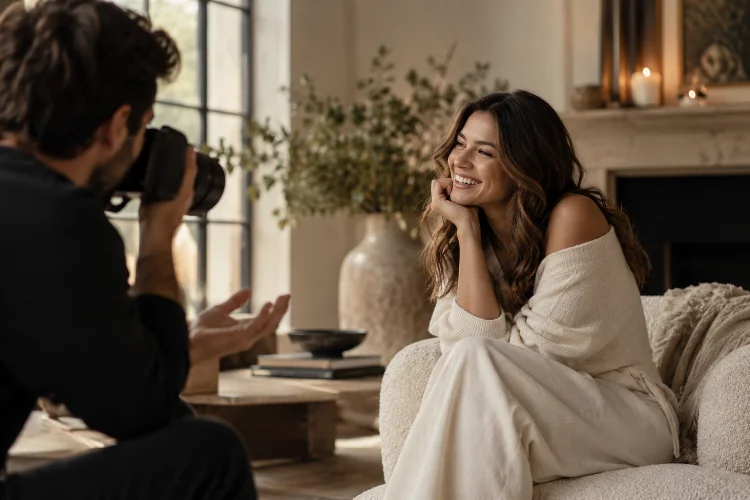
A technically perfect portrait can still feel strangely empty. The lighting may be beautiful, the eyes perfectly sharp, and the composition carefully arranged, yet the expression looks like something the subject switched on because a camera appeared.
Authentic expressions work differently.
They usually emerge when people stop thinking about how they look and begin reacting to something real: a conversation, memory, movement, joke, thought, or interaction. For photographers, the challenge is creating those moments without losing control of the session.
Building authentic expressions through advanced subject direction is therefore less about telling someone exactly what face to make and more about creating conditions where believable reactions can happen.
Good direction combines communication, body language, emotional prompts, timing, and careful observation.
This is especially important when working with non-models, executives, families, actors, or editorial subjects who may not naturally feel comfortable in front of a camera. The stronger your direction becomes, the less visible that direction should eventually feel.
Start With Trust Before Asking for Emotion
It is difficult to photograph a natural expression from someone who is still wondering whether they are standing correctly.
Before chasing emotion, reduce uncertainty.
Nikon portrait photographer Robert Vasquez emphasizes getting to know subjects, explaining the photographic process, and asking questions about what they want from the session. That two-way communication can help people become more comfortable in front of the camera.
You do not need to become someone’s best friend before taking their portrait. You simply need to establish that the session is collaborative rather than an exam they might fail.
Explain what you are doing when useful. Tell them that you will guide their posture and expression instead of expecting them to know how to pose.
That simple reassurance changes the dynamic.
Professional Photographers of America similarly notes that clear communication helps clients understand what to expect and can make sessions feel more relaxed.
When uncertainty falls, genuine expresion becomes much easier to find.
Give Emotional Prompts Instead of Facial Commands
“Smile.”
“Look happy.”
“Be serious.”
These instructions describe the final appearance you want, but they do not give the subject anything meaningful to react to.
Try creating a mental situation instead.
Instead of asking someone to look confident, ask them to imagine walking into a meeting where they already know their idea has been approved. Instead of saying “look thoughtful,” ask them to look past the camera and think about a decision they still have not made.
The exact prompt should fit the person and the purpose of the portrait.
For a relaxed lifestyle shoot, you might ask someone to remember the funniest thing that happened during a recent trip. For an editorial portrait, you may simply ask a question about their work and photograph the moment they begin seriously considering their answer.
Fstoppers’ guidance on portrait direction emphasizes communication and rapport as important tools for moving subjects beyond stiff or copied expressions.
The goal is not to manipulate emotions. It is to give the mind something more interesting to do than think about the camera.
Keep the Conversation Moving While You Shoot
Silence can make inexperienced subjects intensely aware of being photographed.
They hear the shutter, wonder whether their smile looks strange, and start monitoring every movement.
Conversation breaks that loop.
Nikon recommends talking with portrait subjects, making them laugh when appropriate, or asking them to look away to create more candid results.
You can ask simple questions while photographing.
“What do you enjoy most about this work?” can produce a different expression from “What part of the job drives you crazy?”
The words matter because different questions produce different energy.
Pay attention when the subject begins answering rather than waiting until they finish. Facial expressions constantly change during speech. Eyebrows lift, eyes narrow, smiles form gradually, and thoughtful pauses appear naturally.
These micro-moments are often more believable than the expression someone creates after hearing, “Okay, now smile at me.”
Advanced direction sometimes means talking less about photography and more about everything else.
Use Movement to Reset Stiff Expressions
The face is connected to the rest of the body.
If the shoulders are rigid, the hands are clenched, and the subject has been holding one position for thirty seconds, asking for a “natural smile” probably will not solve much.
Reset the body instead.
Ask them to walk a few steps, roll their shoulders, sit down again, adjust a jacket, turn away and return, or shift their weight between their feet.
Fstoppers recommends action-based posing and notes that simple movement, such as walking toward the camera, can create more natural results than leaving someone stationary for too long.
Movement creates transitions, and transitions contain useful expressions.
A person turning back toward the camera may briefly smile before settling. Someone adjusting their sleeve might naturally lower their eyes. A subject sitting down can produce a moment of relaxed concentration before remembering the camera is there.
Keep shooting through those transitions.
Do not assume the final pose is always the best frame.
Often, the photograph you want happens half a second before the pose is technically complete.
Refine the Body Without Interrupting the Emotion
Authenticity does not mean ignoring posture.
A genuine laugh can still be photographed from an unflattering angle. Natural body language may still need refinement.
The challenge is making corrections without destroying the moment.
Adobe recommends small posing adjustments such as slightly angling the body and positioning the chin forward and down while keeping the overall result natural. Adobe’s posing guidance also highlights how hands and seated positions benefit from preparation and clear direction.
Make these changes gradually.
Instead of stopping everything and rebuilding the pose, say, “Keep doing exactly that – just bring your chin a tiny bit toward me.”
Or: “That expression is great. Relax that shoulder.”
Small instructions preserve emotional continuity.
This is where advanced subject direction becomes almost invisible. You are still controlling camera angle, hands, posture, shoulders, and facial position, but the subject does not feel as though the session has repeatedly stopped.
The adjustment should be subtile enough that the interaction keeps moving.
Learn to Read Micro-Expressions Between Poses
A portrait session contains far more expressions than the photographer consciously requests.
The challenge is noticing them.
Watch the subject when they first understand an instruction. Watch when they think you are checking camera settings. Notice what their face does immediately after laughing.
Fstoppers describes slowing down, having casual conversations, and allowing natural expressions and body language to emerge rather than constantly directing every second of a session.
These moments can be extremely brief.
Someone may hold a polished camera smile for several seconds, then breathe out and reveal a much softer expression the instant they believe the photograph is finished.
Keep the camera ready.
Burst shooting is not necessarily the solution. Observation matters more than generating hundreds of nearly identical frames.
Learn the rhythm of the person.
Some subjects relax immediately after an instruction. Others need several seconds. Some produce their best expressions while speaking, while others become more expressive when listening.
Subject direction becomes much stronger when you respond to the individual rather than using the same routine for everyone.
Match Your Energy to the Expression You Want
Photographers often expect subjects to produce energy they themselves are not showing.
If you want enthusiasm while speaking in a flat voice and staring silently through the viewfinder, the direction may feel contradictory.
Adobe’s posing advice notes that photographers can use their own body language to demonstrate the emotion and gestures they want from a subject.
Want relaxed posture? Relax your own shoulders.
Want more energy? Increase your pace slightly.
Want a quiet, serious portrait? Slow down your voice rather than firing instructions rapidly.
This does not mean performing dramatically throughout the shoot. Your energy simply needs to support the atmosphere you are trying to create.
PPA’s discussion of portrait photographer Jonny Edward similarly describes effective direction as collaborative: encouraging subjects, making adjustments, checking comfort, and reinforcing what is already working.
Confidence also transfers.
When you sound uncertain about every instruction, the subject may wonder whether something is going wrong. Calm, clear comunication makes even unusual directions easier to trust.
Know When to Stop Directing
One of the most advanced subject-direction skills is recognizing when additional direction will make the photograph worse.
Sometimes the subject finds the right expression naturally.
Do not interrupt it.
If someone starts telling an emotional story, you may not need to keep saying, “Chin down, eyes here, shoulder back.” Allow the moment to develop and adjust yourself instead.
Move the camera.
Change your framing.
Wait for the expression.
Nikon’s portrait work with Joe McNally and Jerry Ghionis highlights that posing, directing, lighting, and styling all contribute to how a photographer interprets a person’s character. That interpretation does not require controlling every second.
Strong direction establishes the conditions.
Then it creates room for something unexpected.
The best portrait may come from a prompt you planned carefully, or from the moment immediately afterward when the subject laughs because the prompt felt ridiculous.
Both are useful.
Your job is to recognise which moment feels true.
Authentic portrait expressions rarely come from repeatedly asking people to smile. They emerge through trust, conversation, emotional prompts, movement, observation, and small physical adjustments that never overpower the subject’s personality.
Advanced subject direction is ultimately about balancing control with freedom.
Prepare your poses, know the mood you want, and communicate with confidance – but stay responsive to what actually happens during the session.
Watch transitions, listen to answers, keep shooting between instructions, and allow strong moments to continue without unnecessary interference.
During your next portrait shoot, spend less time asking, “What expression should they make?” Instead, ask, “What can I give them to genuinely respond to?” That change alone can move your portraits from technically polished to emotionally believable.