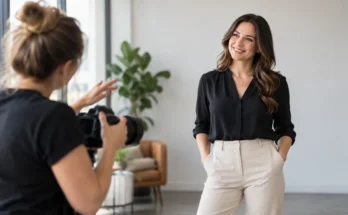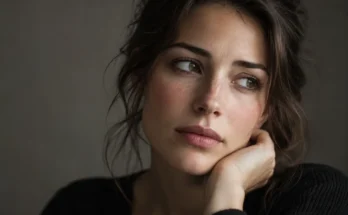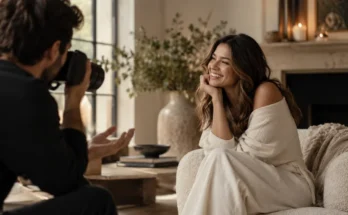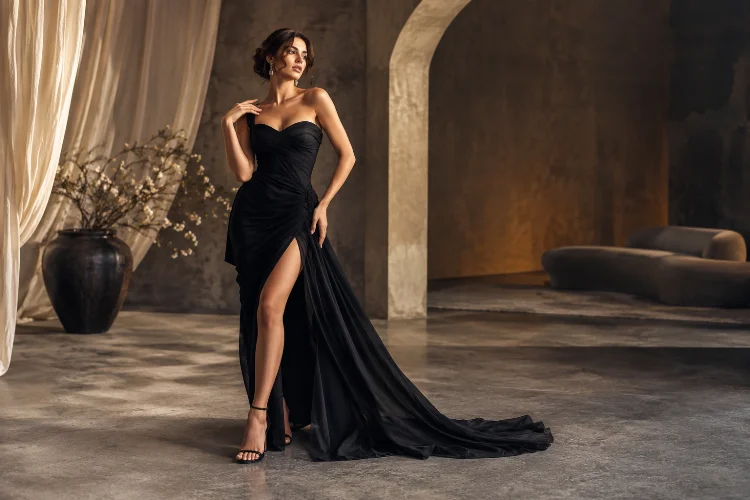
A model can wear an incredible outfit, stand inside a beautiful set, and be photographed with flawless lighting, yet the final image may still feel strangely lifeless. Often, the missing ingredient is not technical. It is body language.
The angle of a shoulder, position of a hand, direction of the torso, or distance between two people can completely change how an editorial image is perceived.
Even when viewers cannot explain exactly why, posture and gesture help shape impressions of tension, confidence, intimacy, elegance, vulnerability, or movement.
That is why body language matters in high-end editorial photography. Editorial images are expected to do more than show clothing or faces. They often need to communicate an idea, mood, or narrative within a single frame.
Adobe describes editorial photography as photography built around storytelling and creative concepts, where poses, surroundings, lighting, and styling work together to extend the story.
When body direction supports that story, a photograph starts feeling intentional rather than merely attractive.
Body Language Adds Meaning Before the Viewer Notices Details
People react to body posture surprisingly quickly.
Before viewers study the clothes, lighting, or background, they may already receive an impression from the way the subject occupies space.
Research on postural communication has found that bodily posture contributes to how observers perceive emotional states, alongside facial expression, movement, voice, and context.
Importantly, these cues should not be treated as perfect evidence of what a person is actually feeling.
For editorial photographers, that distinction is useful.
The goal is not to claim that crossed arms always mean defensiveness or that an upright posture automatically proves confidence. Instead, photographers can use familiar visual associations to shape the atmosphere of a frame.
A model leaning slightly forward may create engagement. A figure leaning away can introduce distance.
A wide stance may feel visually powerful in one fashion story, while a curved, inward posture might better support a quieter and more introspective concept.
Body language becomes another layer of visual design.
Posture Helps Define the Character of an Editorial Portrait
High-end editorial photography frequently creates a character, even when the subject is playing themselves.
Consider a magazine portrait of a business founder.
Photographing the person standing rigidly with shoulders square to the camera creates a very different impression from showing them casually leaning against a desk. Neither approach is automatically better.
The correct posture depends on the editorial narrative.
Nikon recommends slightly turning a portrait subject’s body away from the camera and bringing the head back toward the lens rather than automatically photographing everyone straight-on. This can create more dimensional and visually flattering body positioning.
Editorial photographers can take this idea further.
A fashion subject might twist the torso significantly to emphasize garment structure. A musician could sink deeply into a chair to create a more casual mood. An actor might stand completely centered and upright because the formality itself supports the concept.
Strong posture is not necessarily perfect posture.
It is posture that matches the story.
Hands Can Make or Break an Expensive-Looking Image
Hands attract more attention than photographers sometimes expect.
A carefully styled portrait can quickly feel awkward when the subject does not know what to do with their fingers.
Adobe recommends planning hand placement and seated poses before a shoot, noting that props can sometimes help subjects feel more comfortable and give their hands a natural purpose.
The difference between natural and awkward hand placement is often subtile.
Hands pressed firmly against the body may look tense. Fingers held perfectly straight can feel artificial. Hiding both hands without a compositional reason may make a pose seem incomplete.
Instead, hands can interact with the editorial story.
A model might adjust a cuff, hold the edge of a coat, touch a piece of furniture, rest a hand loosely near the face, or interact with an object related to the feature.
The key is avoiding pointless gestures.
Every hand position does not need symbolic meaning, but it should feel believable within the visual world you are creating.
Movement Creates More Convincing Body Language
Static posing is useful, but high-end editorial photography often becomes more interesting when the subject moves.
Walking, turning, sitting down, adjusting clothing, reaching for something, or shifting weight naturally creates body positions that can be difficult to reproduce through detailed verbal instructions.
Movement also introduces transitions.
A model turning toward the camera passes through several possible poses before reaching the final position.
One of those transitional frames may contain better shoulder alignment, stronger garment movement, and a more convincing gesture than the pose you originally planned.
Research into emotional body perception also suggests that movement carries information beyond static body form. The intensity and character of gestures can influence how bodily cues are interpreted.
For photographers, this means movement is more than a way to loosen up the model.
It can become a compositional tool.
A flowing coat, shifting hair, extended leg, or moving arm can create directional lines through the frame and add energy without requiring dramatic facial expressions.
Spatial Relationships Tell Stories Between People
Body language becomes even more important when multiple subjects appear together.
Where people stand in relation to one another can communicate almost as much as their individual poses.
Imagine photographing two designers for a magazine feature.
Place them shoulder-to-shoulder with similar posture and the photograph may suggest unity. Position one seated while the other stands behind them and the relationship immediately changes.
Separate them across opposite sides of the frame and the image may create independence, contrast, or tension.
Again, those interpretations depend on context rather than universal body-language rules.
The photographer’s job is to consider what the spacing visually suggests within that particular story.
Editorial photography is especially suited to this approach because Adobe describes the genre as narrative-driven rather than purely documentary.
Planning, styling, surroundings, and the relationship between subject and environment all contribute to the final concept.
Distance itself can therefore become part of the narrative.
The Environment Should Influence the Pose
A strong editorial pose should rarely feel pasted onto the location.
The subject should somehow respond to the enviroment.
If you are photographing inside a modern architectural space, the lines of the body might echo or deliberately oppose the lines of the building. In a soft domestic setting, relaxed seated positions may work better than extreme fashion posing.
Furniture can help enormously.
A chair creates opportunities for leaning, turning, extending legs, resting arms, and changing the height of the subject inside the composition.
Walls, staircases, doorways, tables, railings, and floors can perform similar functions.
Adobe’s editorial photography guidance emphasizes paying attention not only to whoever is in front of the camera but also to what surrounds them.
The most sophisticated editorial photographs often make subject and setting feel designed together.
Instead of asking, “Where can my model stand?” ask, “How can the model physically interact with this space?”
That small change in thinking produces much more intentional imagery.
Photographer Body Language Matters Too
Direction does not travel only through words.
Subjects watch photographers constantly.
If you want someone to straighten their posture, demonstrating it yourself may communicate faster than explaining it.
Adobe specifically recommends using your own gestures and posture to demonstrate the emotion or physical position you want from the subject.
This can make direction much more fluid.
Rather than describing a complicated shoulder angle, show it.
If you want a relaxed stance, avoid delivering instructions with frantic energy. If you want dramatic movement, your own physical demonstration can establish the intensity.
This is particularly useful when working with subjects who are not experienced professional models.
Clear comunication also builds confidence.
When direction sounds uncertain, people may start wondering whether they are doing something wrong. Calm, specific instructions make experimentation feel intentional.
High-end images rarely come from simply telling someone to “do something cool.”
They come from collaboration.
Avoid Turning Body Language Into a Checklist
One danger of studying posing is becoming too formulaic.
Photographers can start believing that crossed legs mean one thing, hands in pockets mean another, and certain shoulder positions always communicate confidence.
Human communication is more complicated than that.
Research into postural emotion perception shows that body cues can influence emotional interpretation, but context, accompanying facial expressions, movement, and other information also matter.
That makes rigid body-language formulas unreliable.
For photography, this is actually good news.
You have creative freedom.
Crossed arms might feel defensive in one photograph but sophisticated, relaxed, or simply graphic in another. Looking away from the camera might suggest emotional distance, but it could also feel candid or contemplative.
Judge the complete frame.
Body language works together with styling, expression, lighting, composition, setting, and narrative intension.
The strongest photographers are not memorizing gestures. They are noticing relationships.
Direct the Body, Then Look for the Unexpected
Professional editorial shoots often begin with carefully planned references, mood boards, and pose ideas.
That preparation matters.
But some of the best photographs happen when the plan temporarily loosens.
Adobe notes that editorial shoots need flexibility because ideas often change once photographers meet the subject and experience the location.
Start with deliberate direction, then create variations.
Ask the subject to shift their weight. Let the arms relax. Try the pose from a different camera height. Add movement and photograph the transition.
Watch what happens after you say the shot is good.
Subjects frequently relax immediately, producing body language that feels less constructed. Sometimes that frame becomes stronger than the carefully planned pose.
Advanced direction is therefore a balance.
You control enough to maintain the visual concept while leaving enough freedom for personality to appear.
That combination is one of the things that makes editorial photography feel expensive, polished, and human at the same time.
Body language matters in high-end editorial photography because posture, gestures, movement, hand placement, and spatial relationships all influence how a visual story is experienced.
A strong pose does more than make someone look flattering – it supports character, mood, styling, composition, and narrative.
The most effective approach is not to memorize supposedly universal meanings for every gesture. Instead, evaluate body language within the full context of the photograph.
During your next editorial shoot, watch the entire body rather than concentrating only on the face. Refine hands, experiment with movement, use the environment, and notice how small positional changes alter the frame.
Direct confidently, but leave room for unexpected moments. When every gesture feels connected to the story, the photograph becomes far more convincing.